Launch offer — valid today only

📄 Digital book in PDF · read it on your phone or print it

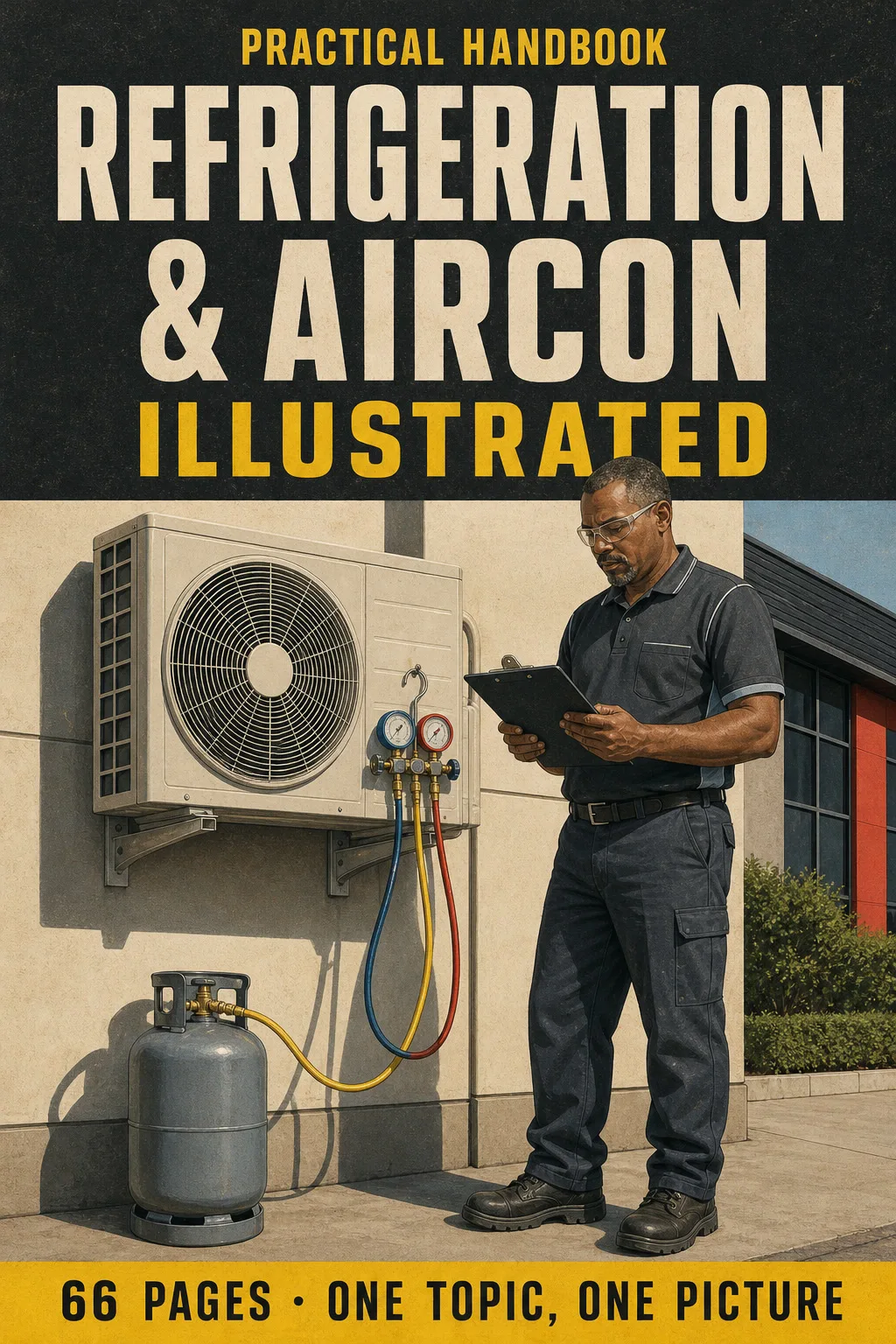
Refrigeration & Aircon in Drawings: Revise for Gas Registration, in kPa and °C Every Topic on Its Own Page

The cycle, gauge and absolute pressure, P-T charts, refrigerant families, nitrogen purge, leak testing, deep vacuum, superheat and fault finding. Every topic has its own page: the drawing first, then what you need to remember. 66 illustrated pages.

I WANT TO REVISE IT IN DRAWINGS

🔒 Secure checkout · PDF by email · 30-day guarantee

Every topic, its own pageEach procedure drawn, with the explanation alongside, in kPa and °C
66 illustrated pages8 parts, from the rules around gas work to the diagnosis flowchart
Up-to-date sourcesOHS Act 85 of 1993, SANS 10147 and current SAQCC Gas registration requirements
PDF by emailFormat

Look Inside the Book

Every page has one large drawing and a box with the pressures, temperatures and steps you need to know:

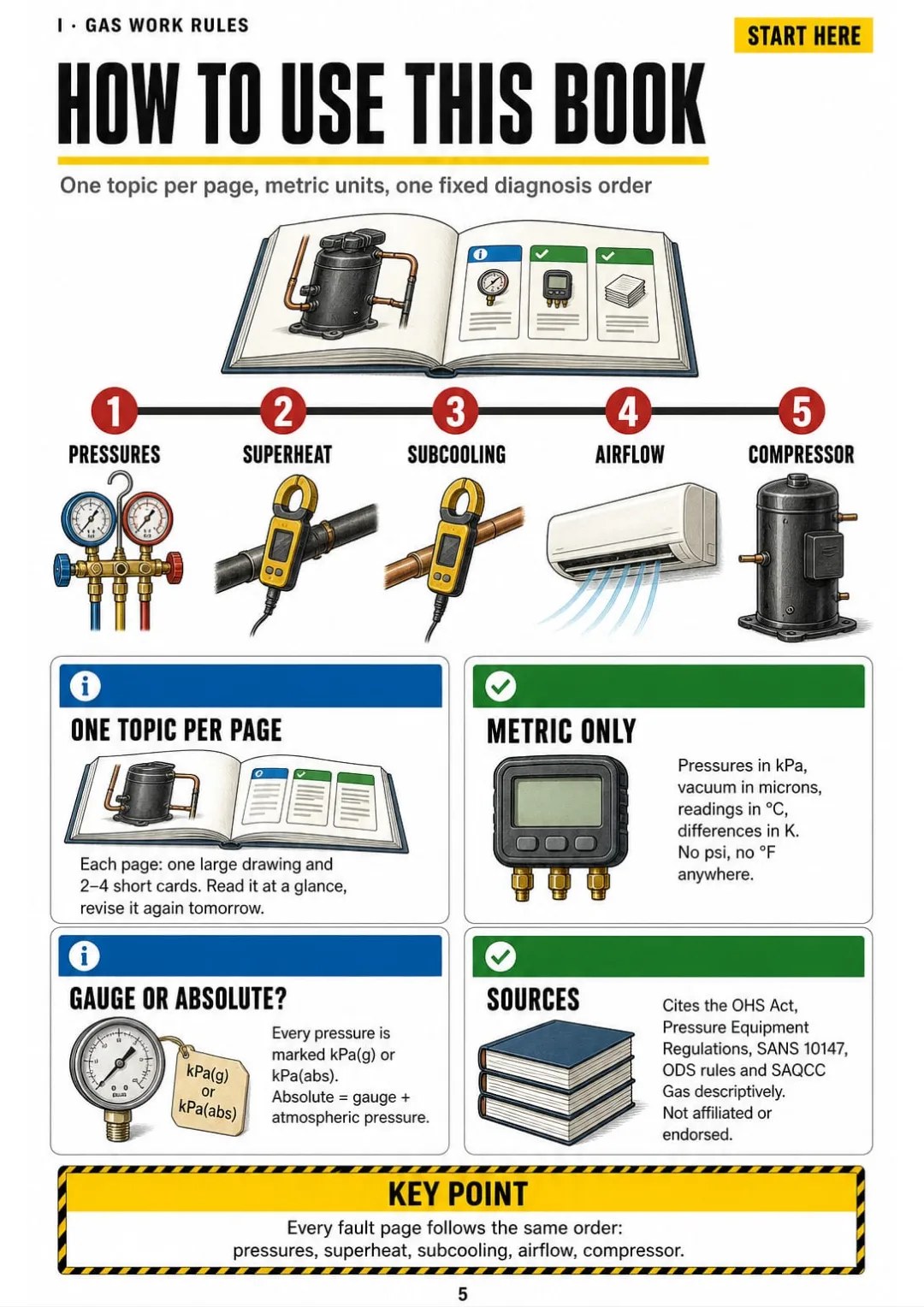
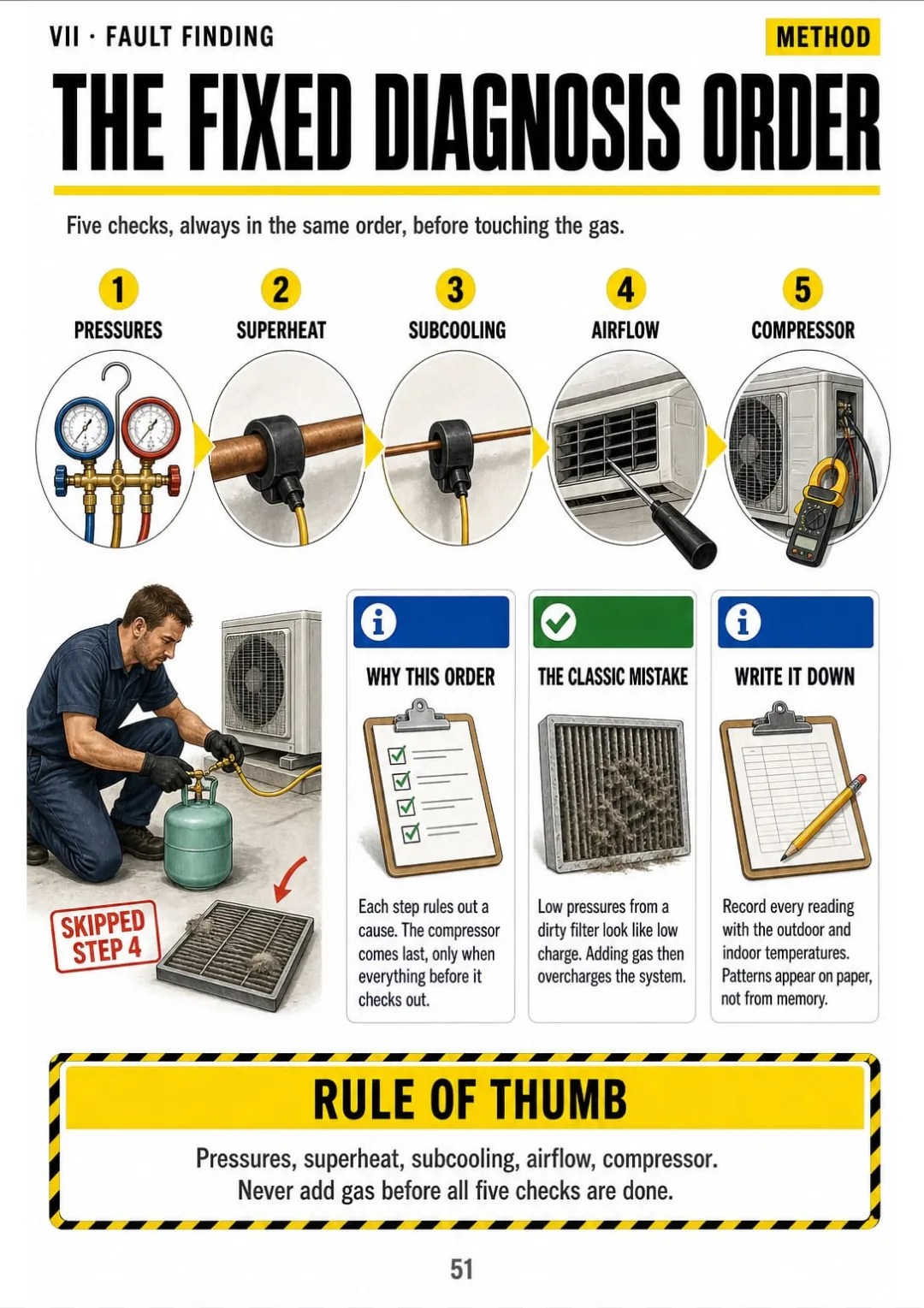
Diagnosis always in the same order: pressures → superheat → subcooling → airflow → compressor
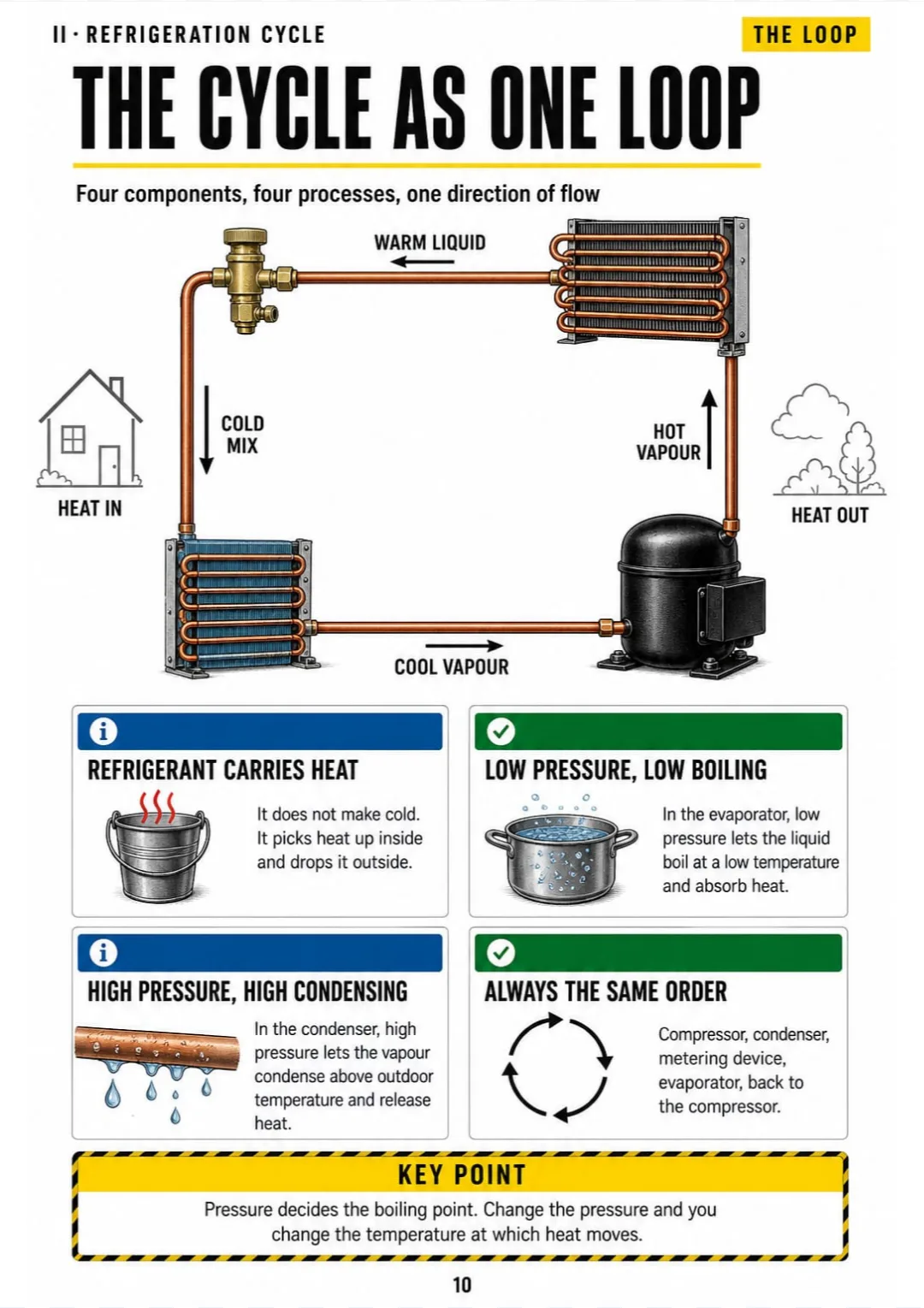
Four components, four processes, one loop: the whole cycle on one page.
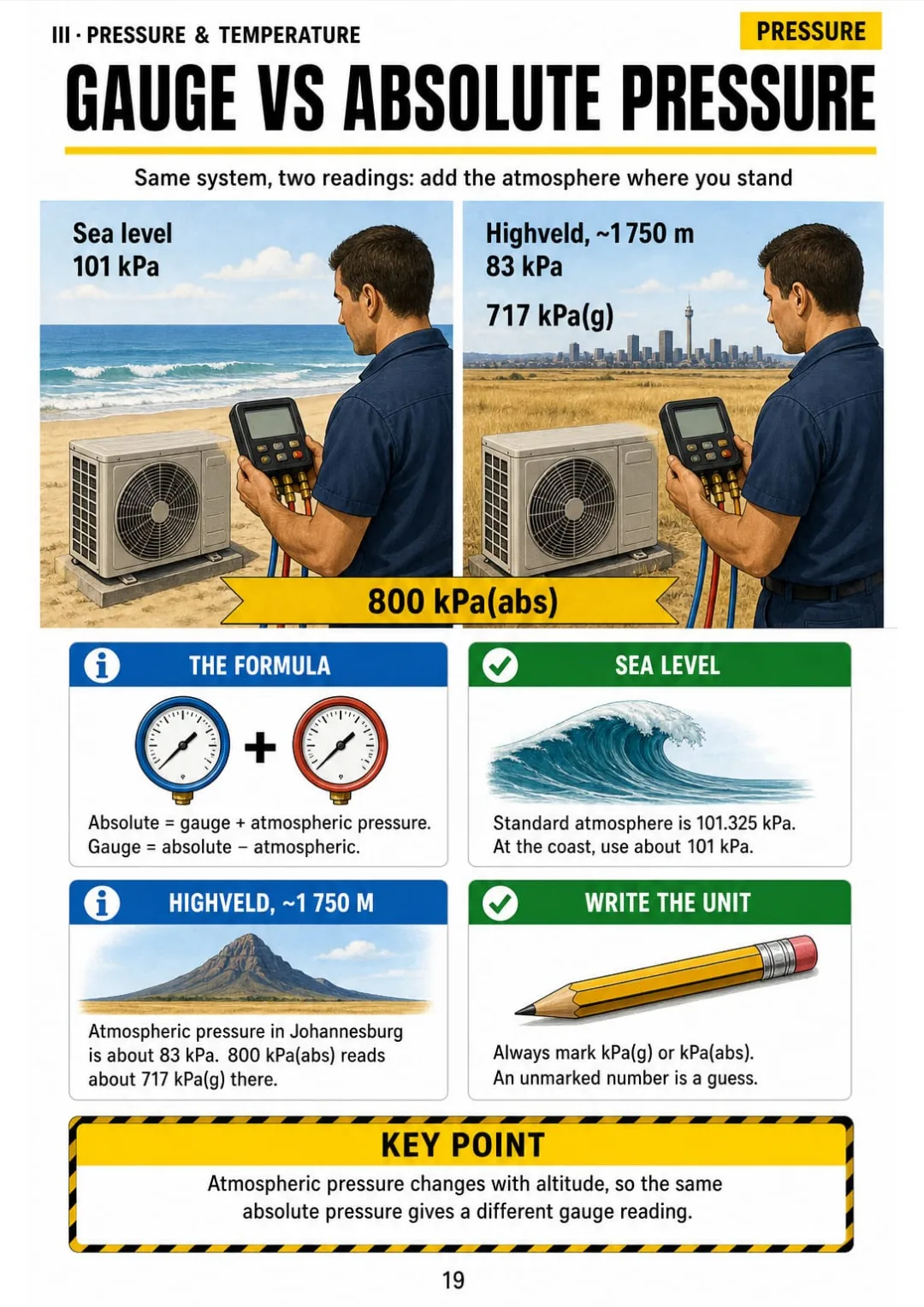
800 kPa(abs) = about 699 kPa(g) at the coast and about 717 kPa(g) in Johannesburg.
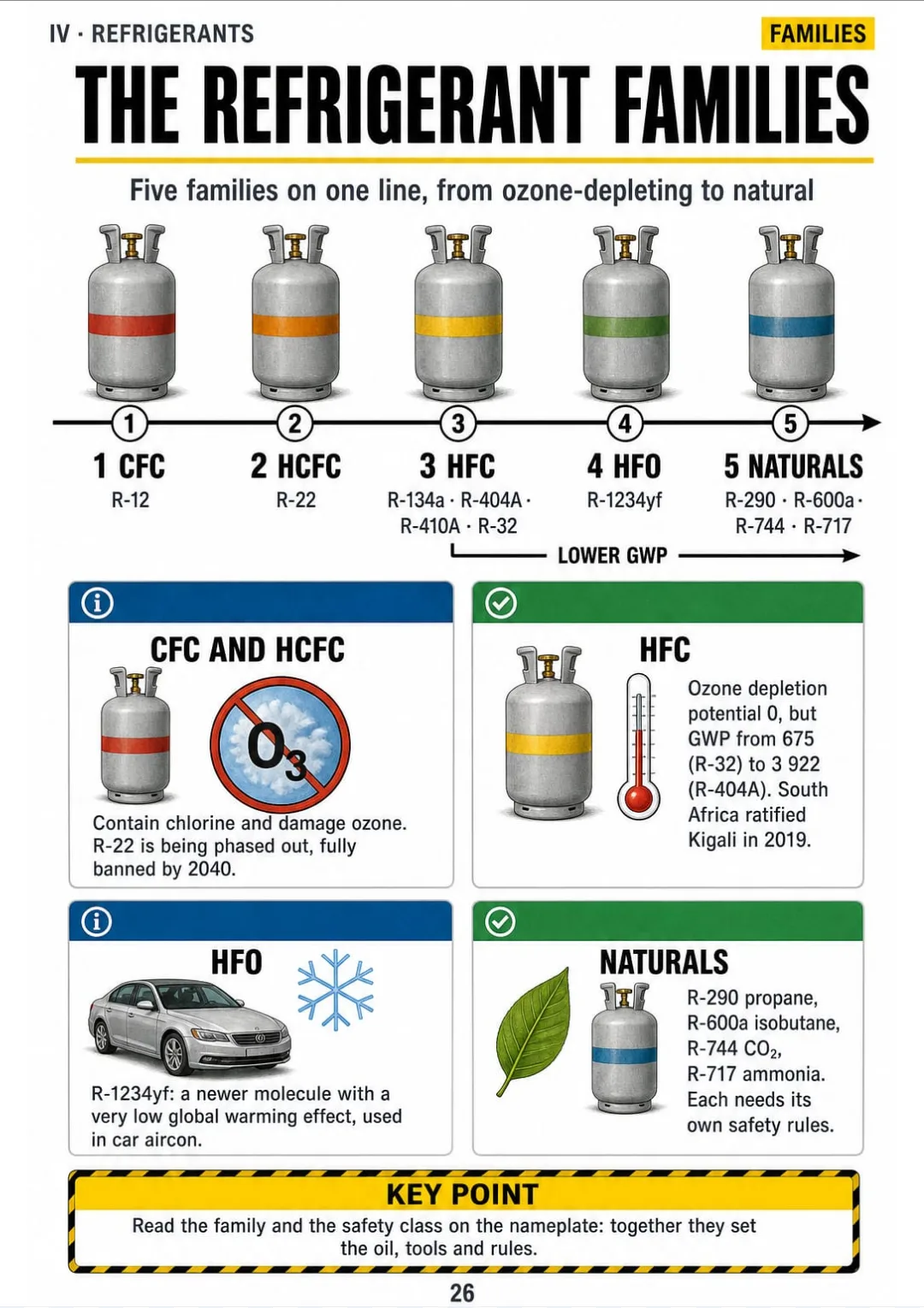
CFC → HCFC → HFC → HFO → naturals, with R-22 to R-717 placed on one timeline
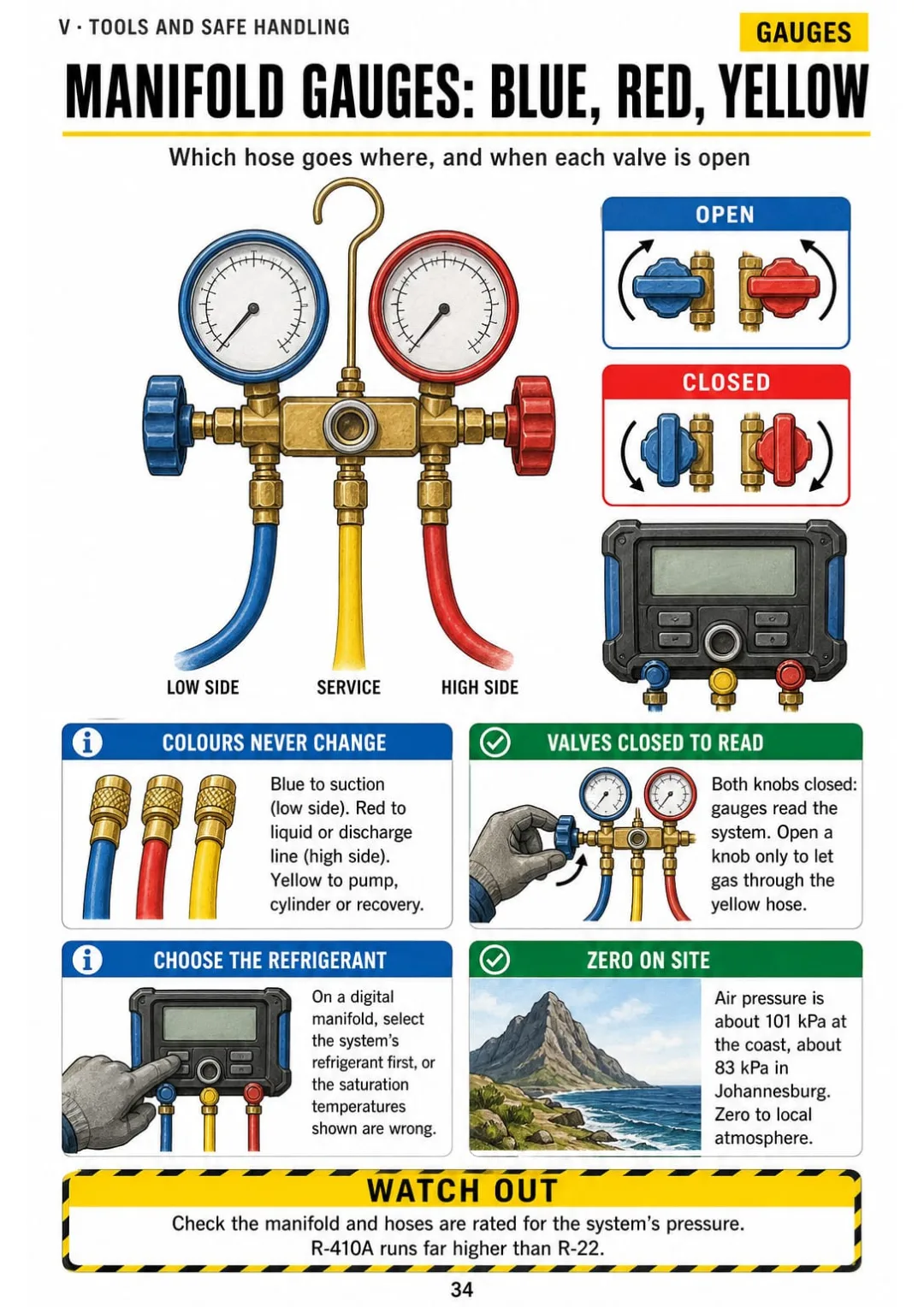
Blue = low side, red = high side, yellow = service; zero the digital manifold to local atmosphere.
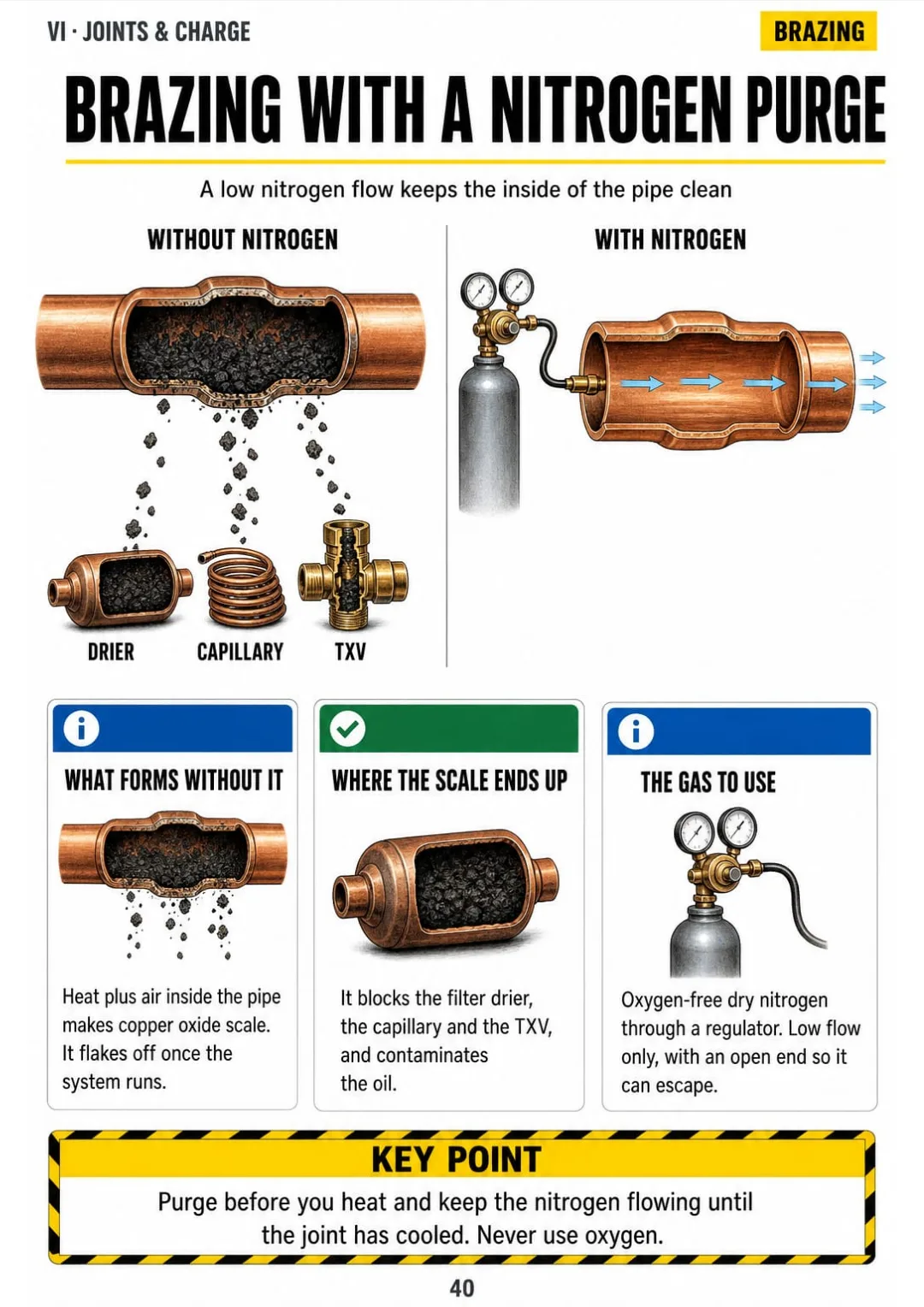
Nitrogen purge vs no purge: clean copper inside, or scale that blocks the TXV.
Pressures → superheat → subcooling → airflow → compressor, every time
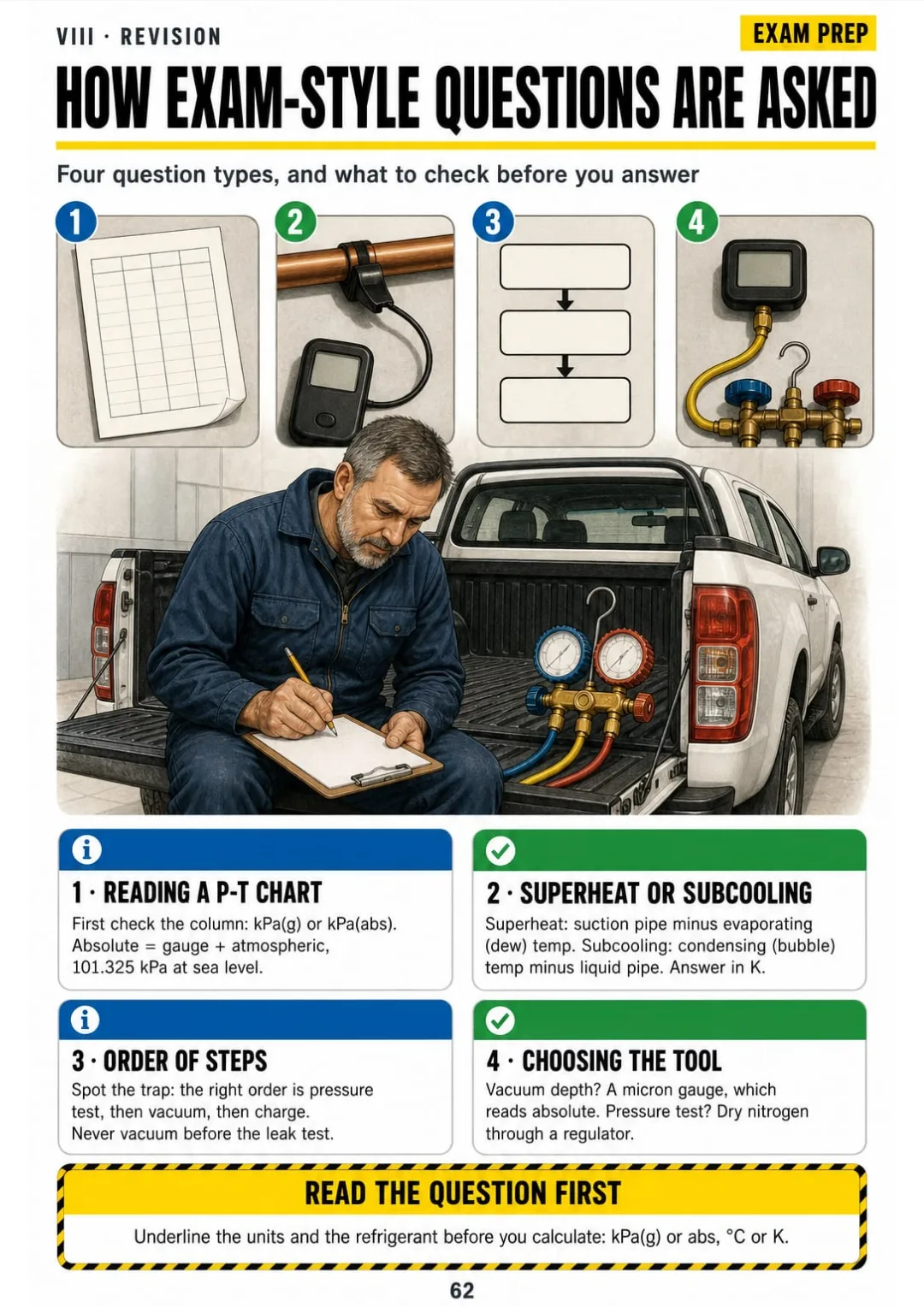
P-T chart, superheat, step order, tool choice: check gauge or absolute first

Swipe to see more →

These are real pages from the book. The table of contents is the full one: 8 parts and 62 topics.

The Problem Isn't You. It's How It Was Explained to You.

You're at the assessment and the question gives a pressure in kPa absolute. Your manifold reads gauge. You stop, unsure which one the chart wants.

The course notes explain it in paragraphs: atmospheric pressure, absolute zero, a figure to add or subtract. Nothing shows you why the same reading changes between Durban and Johannesburg.

800 kPa(abs) = about 699 kPa(g) at the coast and about 717 kPa(g) in Johannesburg.

In the book, gauge vs absolute is one page: two dials side by side, the atmosphere drawn as the gap between them, and the worked example: 800 kPa(abs) is about 699 kPa(g) at the coast and about 717 kPa(g) in Johannesburg.

Saturation, the P-T chart, superheat, the micron gauge and the decay test each have their own page too, drawn the same way.

Next time a question or a reading says abs or g, you know which way to go, without opening the notes.

COMPARE FOR YOURSELF

The Same Topic, Two Ways to Study It

THIS
  • The manual: line after line
  • The refrigeration cycle explained only in words
  • You reach the assessment with doubts
The vapour-compression refrigeration cycle consists of four principal processes. Low-pressure superheated vapour enters the compressor, where its pressure and temperature are raised by a compression process which, in the ideal case, is isentropic. The high-pressure vapour is then discharged to the condenser, in which it rejects heat to the surrounding medium, is desuperheated, condenses and is subsequently subcooled. The liquid then passes through the metering device, undergoing an isenthalpic expansion, after which the low-pressure mixture absorbs heat in the evaporator and returns to the compressor suction.
FOR THIS
  • The cycle as one loop, in a drawing
  • Four components and four processes in a box
  • You see it and you get it
Four components, four processes, one loop: the whole cycle on one page.
CONTENTS

Take a Look at the 8 Parts and 62 Topics

The rules around gas work, the refrigeration cycle, pressure and temperature, refrigerants, tools and safe handling, joints, leak test, vacuum and charge, superheat and fault finding, and revision checklists: 66 pages, all illustrated

IThe Rules Around Gas Work · pp. 5-9
  1. How to Use This Book
  2. Gas Practitioner Registration in Plain Terms
  3. The OHS Act and Pressure Equipment: Who Is Responsible
  4. What SANS 10147 Covers
  5. Never Vent: Refrigerant and the Environment
IIThe Refrigeration Cycle · pp. 10-18
  1. The Cycle as a Simple Circuit
  2. The Compressor: The Pump of the Circuit
  3. The Condenser: Where the Heat Leaves
  4. The Metering Device: Capillary, TXV and EEV
  5. The Evaporator: Where the Heat Comes In
  6. High Side and Low Side
  7. The Split System Drawn
  8. The Cold Room System Drawn
  9. The Heat Pump and the Reversing Valve
IIIPressure and Temperature · pp. 19-25
  1. Gauge vs Absolute Pressure
  2. Saturation: Boiling Point Depends on Pressure
  3. Reading a P-T Chart in kPa and °C
  4. Kelvin for Differences, °C for Readings
  5. Sensible Heat and Latent Heat
  6. The Pressure-Enthalpy Diagram, Simplified
  7. Altitude, Gauges and Vacuum Readings
IVRefrigerants · pp. 26-33
  1. The Refrigerant Families
  2. Safety Classes: A1, A2L, A3, B2L
  3. ODP and GWP Without the Jargon
  4. R-410A: The High-Pressure Blend
  5. R-32: The Mildly Flammable Single Refrigerant
  6. Hydrocarbons: R-290 and R-600a
  7. Blends and Glide
  8. Oils: Mineral, Alkylbenzene and POE
VTools and Safe Handling · pp. 34-39
  1. Manifold Gauges: Analogue and Digital
  2. Hoses, Core Tools and Ball Valves
  3. Nitrogen Cylinder and Regulator
  4. Vacuum Pump and Micron Gauge
  5. Recovery Machine and Cylinder: the 80% Rule
  6. PPE, Cylinders and the Bakkie
VIJoints, Leak Test, Vacuum and Charge · pp. 40-50
  1. Brazing with a Nitrogen Purge
  2. Flare Joints Done Right
  3. Strength Test vs Tightness Test
  4. The Nitrogen Pressure Test Step by Step
  5. Finding a Leak: Bubbles, Electronic, Dye
  6. Deep Vacuum to 500 Microns
  7. The Decay Test: Leak or Moisture?
  8. Charging by Weight
  9. Charging Blends as Liquid, Safely
  10. Recovery Step by Step
  11. Commissioning and the Job Record
VIISuperheat, Subcooling and Fault Finding · pp. 51-61
  1. The Fixed Diagnosis Order
  2. Measuring Superheat: Worked Example
  3. Measuring Subcooling: Worked Example
  4. Target Superheat by Metering Device
  5. Airflow: the ΔT Across the Coil
  6. Pattern: Low Charge
  7. Pattern: Overcharge
  8. Pattern: Restriction or Blocked Drier
  9. Pattern: Non-Condensables
  10. Pattern: Dirty Condenser or Bad Fan
  11. Pattern: Inefficient Compressor
VIIIRevision and Practical Checklists · pp. 62-66
  1. How Exam-Style Questions Are Asked
  2. The Numbers to Know on One Page
  3. Checklist: Pressure Test, Vacuum, Charge
  4. The Most Common Mistakes at a Glance
  5. The Diagnosis Flowchart

One Page, One Topic, All Clear

Think of it this way:

A split on a call-out is running, but the customer says it isn't cooling. You have to decide: low charge or poor airflow?

In the book you open the page on the fixed diagnosis order and see it drawn: pressures, superheat, subcooling, airflow, compressor, each with the reading to take.

Blue = low side, red = high side, yellow = service; zero the digital manifold to local atmosphere.

The same goes for the nitrogen pressure test, deep vacuum to 500 microns, the decay test, charging by weight and the 80% rule for recovery cylinders: each one on its own page.

Refrigeration & Aircon Illustrated is 8 parts and 62 topics, all drawn, with exam-style questions, the numbers to know and job checklists at the end.

What you see drawn, you don't have to memorize.

What's Inside Refrigeration & Aircon Illustrated:

Ipp. 5-9

The Rules Around Gas Work

Gas practitioner registration in plain terms, who is responsible under the OHS Act, what SANS 10147 covers and why refrigerant is never vented.

IIpp. 10-18

The Refrigeration Cycle

The cycle as one loop, compressor, condenser, metering device and evaporator, high and low side, split systems, cold rooms and the reversing valve.

IIIpp. 19-25

Pressure and Temperature

Gauge vs absolute pressure, saturation, P-T charts in kPa and °C, kelvin for differences, sensible and latent heat, and altitude: so a reading in abs or g no longer stops you, at the coast or in Joburg.

IVpp. 26-33

Refrigerants

The refrigerant families, safety classes, ODP and GWP, high-pressure blends, mildly flammable refrigerants, hydrocarbons, glide and oils.

Vpp. 34-39

Tools and Safe Handling

Manifold gauges, hoses and core tools, the nitrogen regulator, vacuum pump and micron gauge, recovery cylinders and the 80% rule, PPE.

VIpp. 40-50

Joints, Leak Test, Vacuum and Charge

Brazing with a nitrogen purge, flares, strength vs tightness test, finding leaks, deep vacuum, the decay test, charging, recovery and commissioning.

VIIpp. 51-61

Superheat, Subcooling and Fault Finding

The fixed diagnosis order, superheat and subcooling with worked examples, airflow ΔT and the most common fault patterns: so on a not-cooling call-out you know what to check first.

VIIIpp. 62-66

Revision and Practical Checklists

How exam-style questions are asked, the numbers to know on one page, practical checklists, the most common mistakes and the diagnosis flowchart.

At the end of the book: Exam-style questions, the numbers to know on one page, job checklists and a diagnosis flowchart.
Plus: 2 Free Books

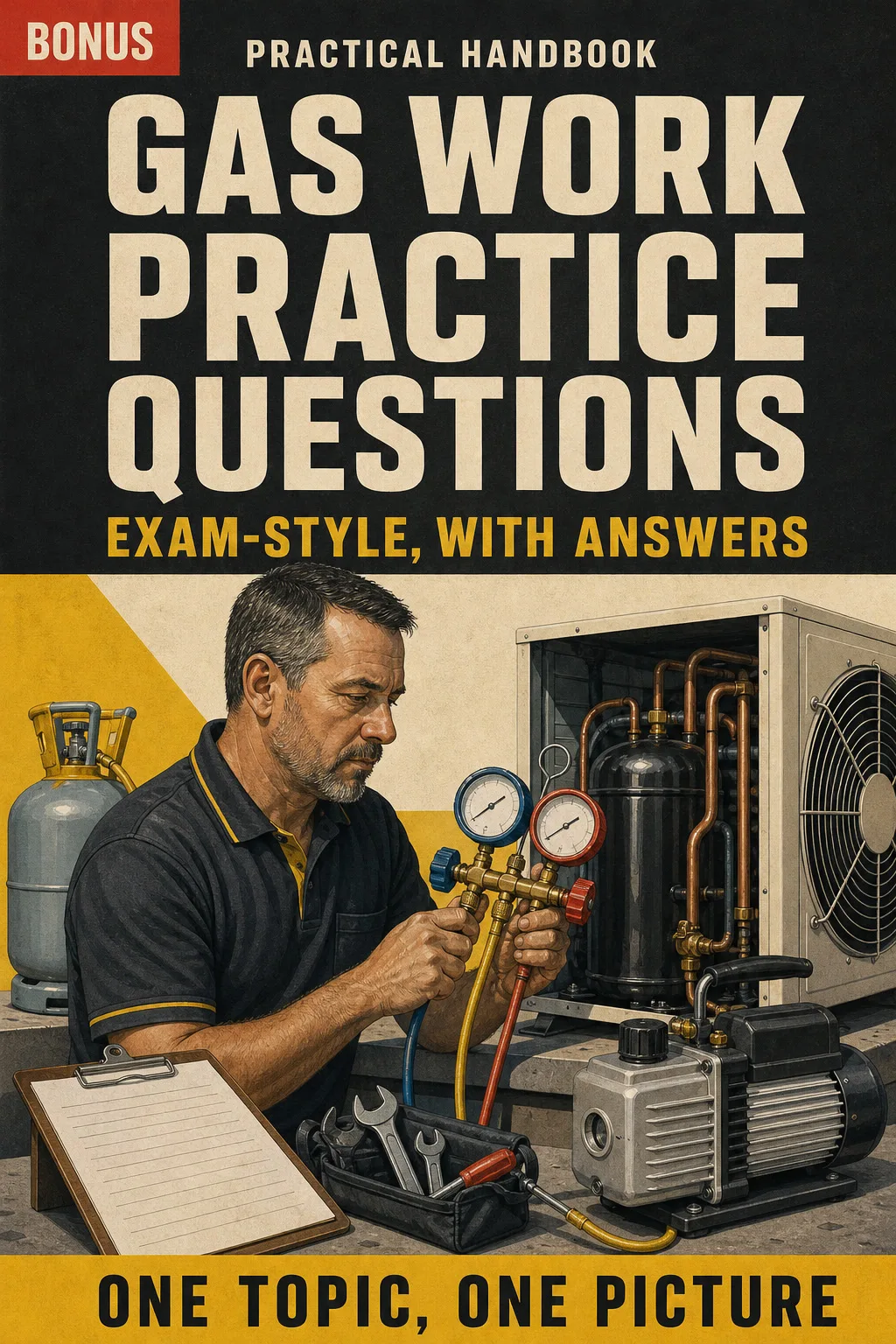
Gas Work Practice Questions: Exam-Style, with Answers

BONUS 1: «Gas Work Practice Questions: Exam-Style, with Answers»

Value on its own: US$ 17.90

Test yourself on every topic in the book and see straight away where you still hesitate, with each answer explained.

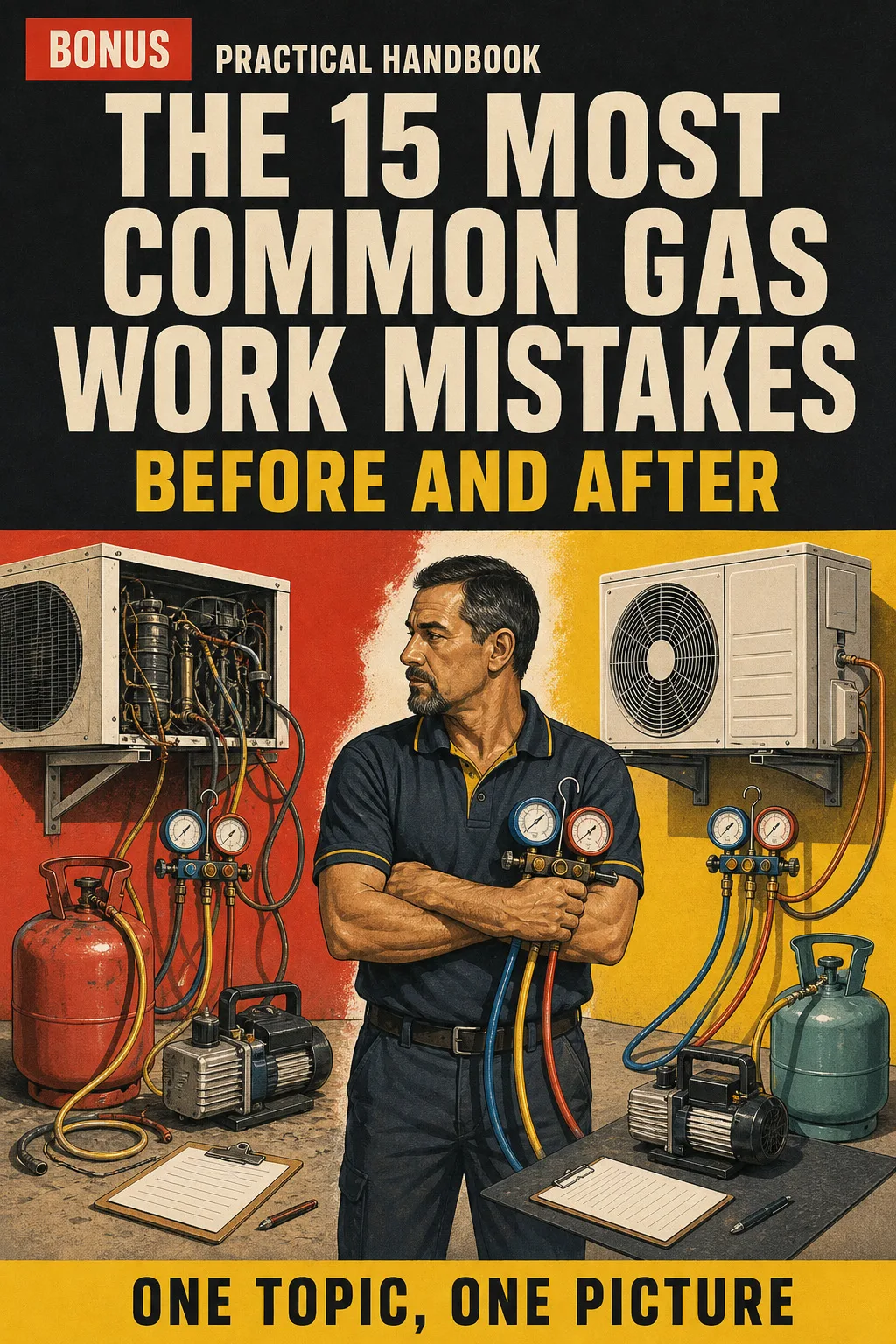
The 15 Most Common Gas Work Mistakes: Before and After

BONUS 2: «The 15 Most Common Gas Work Mistakes: Before and After»

Value on its own: US$ 14.90

See the slips that happen most often on site, from brazing without a nitrogen purge to charging by guesswork, each drawn next to the right way to do it.

Refrigeration & Aircon Illustrated with 2 Free Books

  • Refrigeration & Aircon Illustrated: 66 illustrated pagesUS$ 63
  • BONUS 1: Gas Work Practice Questions: Exam-Style, with AnswersUS$ 17.90
  • BONUS 2: The 15 Most Common Gas Work Mistakes: Before and AfterUS$ 14.90
  • High-resolution PDF to printIncluded
Total value US$ 95.80
YOUR PRICE:
US$ 27
You save US$ 68.80
YES, I WANT REFRIGERATION & AIRCON ILLUSTRATED FOR US$ 27

📄 This is a digital PDF book sent to your email: nothing is printed or shipped.

Secure purchaseEncrypted payment30-day guarantee

PDF by email: We email you Refrigeration & Aircon Illustrated as a PDF, together with the two free books. It's a single payment: no installments, no extra charges.

Who This Book Is For

You're preparing for gas registration

You're preparing for gas registration

The theory behind the work you already do, in order and drawn, in kPa and °C, so you can revise it topic by topic.

Your assessment or refresher is close

Your assessment or refresher is close

Exam-style questions, the numbers to know on one page and the procedures step by step, for a last revision before the day.

You already run jobs or train apprentices

You already run jobs or train apprentices

A page to open on site or hand to a new apprentice: the vacuum, the pressure test or the diagnosis order, drawn and always in the same sequence.

Everything You Get Today

US$ 95.80US$ 27
YES, I WANT REFRIGERATION & AIRCON ILLUSTRATED FOR US$ 27

📄 This is a digital PDF book sent to your email: nothing is printed or shipped.

30DAYS
GUARANTEE

30-Day Guarantee

Try Refrigeration & Aircon Illustrated for 30 days, bonus books included.

We refund everything if the file won't open, if the book isn't what you see here, if you were charged twice or if the email doesn't arrive. Just email us.

You pay once. No subscriptions.

Frequently Asked Questions

Is it for me if I've been on the tools for 20 years?

Yes. It doesn't teach you the job you already do: it puts the theory behind it in order, drawn and in kPa and °C, so you can revise it and explain it with confidence.

Where does the content come from?

From South African sources: the Occupational Health and Safety Act 85 of 1993 and its Pressure Equipment Regulations, SANS 10147, the national rules on ozone-depleting substances and the current gas practitioner registration requirements, checked against the versions in force. Everything is in kPa and °C, with altitude worked out for the coast and Johannesburg. It isn't US material converted from psi and °F.

Is it official material?

No. It's an independent study guide, not affiliated with or endorsed by SAQCC Gas or any other authority. It covers the theory and procedures behind refrigeration and air-conditioning gas work; check which category you need and the current requirements directly with the registration body.

Does it replace the course or practical training?

No. It's a study and revision aid: it doesn't give you a certificate, a registration or any points towards it. Brazing, flammable refrigerants and pressure testing still need proper hands-on training and your registration body's requirements.

Are the practice questions the ones in the exam?

No. They are written for this book, in the style of exam questions, to help you see where you still hesitate.

How does it arrive?

As a PDF by email, together with the 2 bonus books.

Do I have to pay every month?

No. It's a one-off payment.

Can I have it on paper?

Yes. The PDF prints on standard A4, so you can keep the pages you need in the bakkie.

How does the refund work?

You have 30 days. We refund everything if the file won't open, if the book isn't what you see on this page, if you were charged twice or if the email doesn't arrive: just email us.

Before You Close This Page

No more rereading notes that don't stick.

Superheat and subcooling: you see them drawn, and that's it.

You get to the assessment knowing where everything is.

Drawings make studying faster.

The book is right below.

One-time payment: US$ 27 · Guarantee: 30 days · PDF by email

YES, I WANT REFRIGERATION & AIRCON ILLUSTRATED FOR US$ 27

📄 This is a digital PDF book sent to your email: nothing is printed or shipped.